Our building is at 601 N 1st Street, three minutes from the Garland industrial corridor. We are not a national brand subcontracting your roof to whoever answered the phone — the crew on your deck works for the company whose name is on the contract.
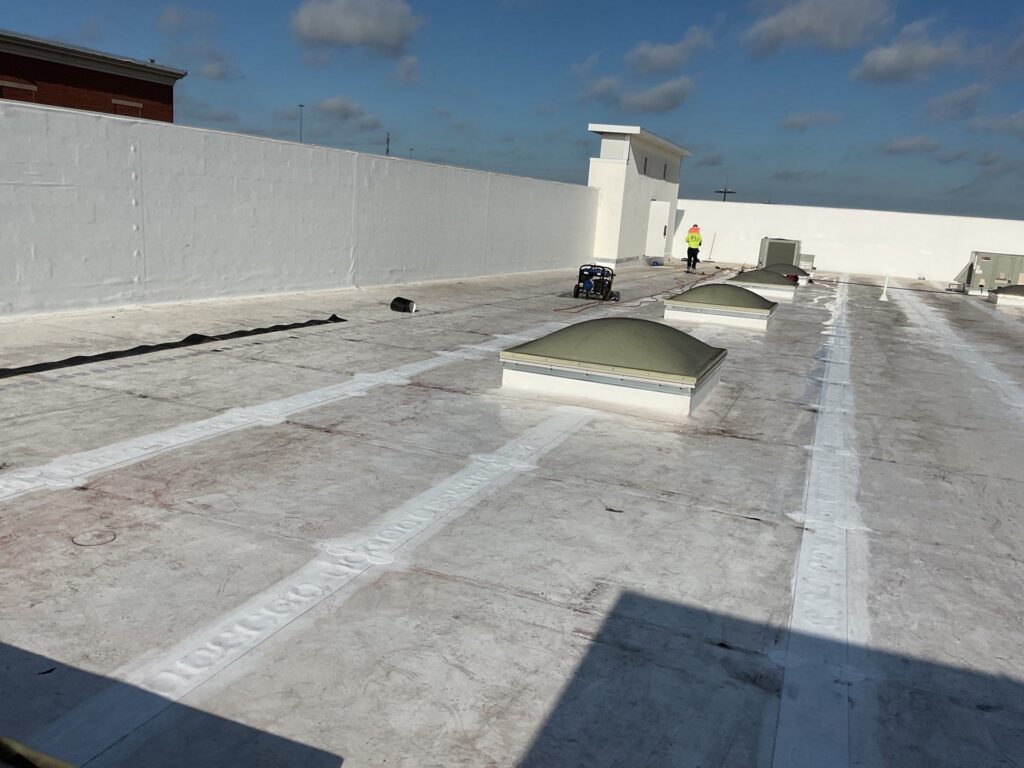
Roof Experts is a commercial roofing contractor headquartered in Garland, Texas. We repair, replace and maintain low-slope and metal roof systems for warehouse, distribution, retail, office, restaurant, multifamily, church, school and light-industrial buildings across Garland and the wider DFW metroplex.
Being based here matters more for commercial work than it does for residential. A house with a leak is an inconvenience. A warehouse with a leak is inventory on the floor, a tenant with a claim, or a production line stopped — and the difference between a two-hour response and a two-day response is measured in real money. Our shop, our trucks and our crews are in Garland.
North Texas is one of the hardest hail environments in the country. Texas has led the United States in major hail events — one inch or larger — for ten consecutive years, with a record 1,123 events in 2023 and 878 in 2024 according to Insurance Institute for Business & Home Safety analysis of National Weather Service data. Garland sits in the middle of that.
Hail is not the only thing working on a low-slope roof here, and often it is not the thing that finally causes the leak. Summer deck temperatures, thermal cycling across a 60-degree seasonal swing, ponding water that never fully drains, foot traffic from HVAC servicing, and rooftop equipment that gets replaced without anyone properly re-flashing the curb — those are the failures we are called out for most often.
There is money in telling a building owner that a roof needs full replacement. There is less money in patching it, and a good deal less money in telling you it has five years left. We would rather have the second conversation and keep the building for the next fifteen years.
Every assessment comes with photographs of the actual condition, a written scope, and a straight recommendation. If we say replace, you will be able to see why.
The default choice for most new commercial work in this climate. It is a reflective white membrane, which matters in a Texas summer, it is heat-welded rather than glued so the seams are strong, and it carries system warranties in the 20 to 25 year range. At 60 mil in approved configurations it achieves Class 4 impact resistance — worth raising with your insurance carrier, because a hail-mitigation credit can be meaningful on a large roof.
Black synthetic rubber, very long service record, very forgiving to repair. It absorbs heat rather than reflecting it, which is a real consideration here, but on the right building — particularly where the roof is heavily penetrated and future modifications are likely — its repairability is an advantage.
The system to specify where the roof will see grease, chemical exhaust or heavy foot traffic. Restaurants and food processing are the obvious cases: PVC resists the grease that will degrade TPO around a kitchen exhaust.
Multi-ply asphalt systems, torch-down, self-adhered or hot-applied. A great deal of older Garland commercial and industrial stock is on modified bitumen or BUR, and a well-maintained one has a lot of life in it. Converting to single-ply is sometimes the right call and sometimes an expensive answer to a problem that a proper repair would solve.
For steeper commercial slopes, churches, schools and buildings where service life and appearance both matter. Long life, minimal maintenance, higher up-front cost, and the details — fastener choice, clip spacing, panel expansion — decide whether it lasts forty years or twelve.
Warehouse and distribution. Large single-ply fields, few penetrations, high consequence when they leak. Ponding and seam integrity are the usual issues, and the economics almost always favour a maintenance contract over reactive repair.
Retail and restaurant. Heavily penetrated roofs with constant HVAC and exhaust work. For kitchens, grease resistance drives the system choice. Work is scheduled around trading hours.
Office and medical. Low tolerance for interior disruption and for any water event at all near equipment or records. Phased work and strict containment.
Multifamily. Occupied buildings, tenant notice requirements, and the need to keep every unit dry through the work. Steep-slope shingle and low-slope membrane frequently on the same property.
Churches and schools. Long-horizon owners with real budget constraints, often with metal or modified bitumen and often with the work confined to holidays and out-of-term windows.
Mechanically attached or fully adhered, with the attachment pattern specified to the wind zone rather than to a brochure. Garland's adopted design wind speed is 115 mph three-second gust, and perimeter and corner enhancement is where a low-slope roof either holds or peels.
Two-ply and three-ply mod bit, torch, cold-adhered and self-adhered, plus traditional built-up where an existing system and a tight budget call for it. Torch work on an occupied building gets a written hot-work plan and a fire watch, not a shrug.
Silicone and acrylic restoration where the membrane is sound and the insulation is dry — which is a determination made by core sample, not by looking at it. Where it is not sound we will tell you a coating is the wrong product, even though it is the easier sale.
Standing seam, R-panel and metal retrofit over existing low-slope, plus the flashing, curb and penetration detailing that decides whether a metal roof is watertight or merely new.
Scheduled inspection with a documented condition report, drain and scupper clearing, and same-day leak response — which for a Garland property means a truck from First Street, not a dispatch queue.
Core samples, moisture survey, remaining-service-life estimate and a repair-versus-replace recommendation you can put in a budget. Sometimes that recommendation is that your roof has six good years left, and we will say so in writing.
We cut and patch cores to establish what is actually on the deck: how many layers, what the insulation is, whether it is wet, and what the deck itself is. Nobody can price a commercial re-roof honestly without that, and a bid produced without it is a guess dressed as a number.
Garland is on the 2015 IRC while Richardson, Rowlett, Sachse and Dallas are all on 2021. At and above $2,000 in job value a permit is required and the work must be done by a city-registered contractor. We build the permit packet, including the signed contract or adjuster's scope of loss the application requires.
Sequenced so the building stays open and dried in overnight, with work hours inside Garland's window, staging agreed in advance, and no section opened wider than we can close before weather. On an occupied building the plan matters as much as the membrane.
Photographic record of the deck, the insulation, the attachment, the flashing and the finished field, plus warranty registration and the closeout file. A commercial roof is an asset on your balance sheet and it should have a paper trail that matches.
The default for new and replacement low-slope work in this market. Reflective, which matters in a Texas summer, and available in mechanically attached or fully adhered systems with manufacturer warranties running well past twenty years.
Two- and three-ply systems, torch-applied, cold-adhered or self-adhered. Tough underfoot, forgiving of foot traffic around rooftop equipment, and the right answer on a building with a lot of penetrations and service access.
A genuine option where the existing membrane is sound and the insulation is dry, extending service life without a tear-off and without the disruption. It is the wrong answer on a wet roof, and we determine which you have with core samples first.
Written warranty on the installation itself, separate from whatever the membrane manufacturer offers. Our address has not moved since 2019, which is the part of a warranty that actually matters.
NDL and material warranties available on qualifying single-ply and modified bitumen systems, subject to the manufacturer's inspection and to the system being installed to their published specification — which is why the spec is not a suggestion.
We come back and look at it. Drains, laps, terminations and penetrations, before the first full storm season is behind you rather than after.
Don't see your question? Call us at (469) 936-7663 — we're happy to talk it through.
Yes, once the job is worth $2,000 or more — which every commercial re-roof is. That same $2,000 threshold also requires the work to be performed by a contractor registered with the City of Garland, so it is two requirements switching on at one figure. The application also requires a signed contract or an insurance adjuster's scope of loss attached.
To hold City of Garland contractor registration: $300,000 per occurrence, $600,000 general aggregate and $300,000 property damage, written by an A-rated carrier. On a commercial building you should ask for the certificate and check the carrier rating rather than accepting a PDF at face value.
Because everything about the price depends on what is under the membrane, and none of it is visible from the surface. Core samples tell us how many existing layers there are, what the insulation is, whether it is wet, and what the deck is made of. A bid produced without cores is a guess — and the gap between the guess and reality shows up as a change order once the roof is open.
Sometimes, and it is a genuinely good option when it fits. A silicone or acrylic restoration extends service life without a tear-off and without disrupting your tenants — but only where the existing membrane is sound and the insulation is dry. We establish that with cores before recommending it. Coating a wet roof traps the water and buys you a worse problem in four years.
Garland adopted the 2015 International Residential Code by Ordinance 6850 and has stayed there, which puts it two cycles behind Richardson, Rowlett, Sachse and Dallas. The adopted design wind speed is 115 mph three-second gust. A contractor working the whole metro off one mental checklist will detail a Garland roof to the wrong rulebook.
That is most of what commercial phasing is. We sequence so the building stays open, nothing is opened wider than we can dry in before weather, staging is agreed in advance rather than negotiated in your parking lot, and work runs inside Garland's permitted hours. On torch or hot-air work there is a written hot-work plan and a fire watch.
We are at 601 N 1st Street in Garland. For a Garland commercial property that is a truck leaving our own yard, not a dispatch decision made in another city. Same-day response on an active leak is the normal expectation here, not an upgrade.
We document the damage properly, meet the adjuster on the roof, and supply the scope — which in Garland doubles as one of the two documents the city will accept on the permit application. What we will not do is promise you an approval or inflate a scope. On a commercial claim that is how an owner ends up in a coverage dispute they did not need.
Free inspection, honest scope, real warranty. Most service work scheduled within 24–48 hours.
(469) 936-7663